Of all the periods we handle, Art Deco is the one customers ask for by name. Other eras have their devoted followings, and rightly so, but it is the geometry of the 1920s and 30s that most people seem to carry a picture of before they have even walked through the door.
The reason, we think, is that the style has simply refused to date. Set a ring made in 1925 beside something from a Bond Street window this season and the older piece will more often than not hold its own, occasionally to the point of making its modern neighbour look a little timid. Much of this comes down to a single decision made across the whole period: Art Deco was the moment jewellery stopped imitating nature and began to borrow instead from architecture. That shift has worn remarkably well. The era itself lasted barely twenty years, bracketed by one war and the approach of another, yet the quantity of genuinely accomplished design it produced in that short window is one of the reasons it remains so collected today.
Where the Style Came From
The name arrived later than the thing it describes. It derives from the Exposition Internationale des Arts Décoratifs et Industriels Modernes, held in Paris in 1925, though the term itself would not come into common use for decades afterwards. By the time that exhibition opened its doors the style was already well established; the show simply gave it a stage grand enough to be remembered by.
Its influences are worth understanding, because they surface again and again in the pieces themselves. The opening of Tutankhamun’s tomb in 1922 set off a fashion for Egyptian motifs that ran through the entire decade, which is why scarabs, lotus flowers, and stylised hieroglyphic forms appear so often in work of the period. Cubism supplied the hard geometric edges. A pronounced Asian influence, particularly the use of carved jade and coloured stones, runs through Cartier’s celebrated Tutti Frutti pieces and through much else besides. To this you can add the theatrical colour of the Ballets Russes, the bold forms of African art, and the general optimism of a newly mechanised age. Out of that unlikely mixture came a style whose defining quality, above any single motif, was confidence. The V&A’s history of jewellery traces how the era fits within the wider story of the craft, including the shift back towards gold in the early 1930s.
What Makes Art Deco Distinctive
Several characteristics mark the period out, and once you have handled a few pieces they become almost second nature to recognise.
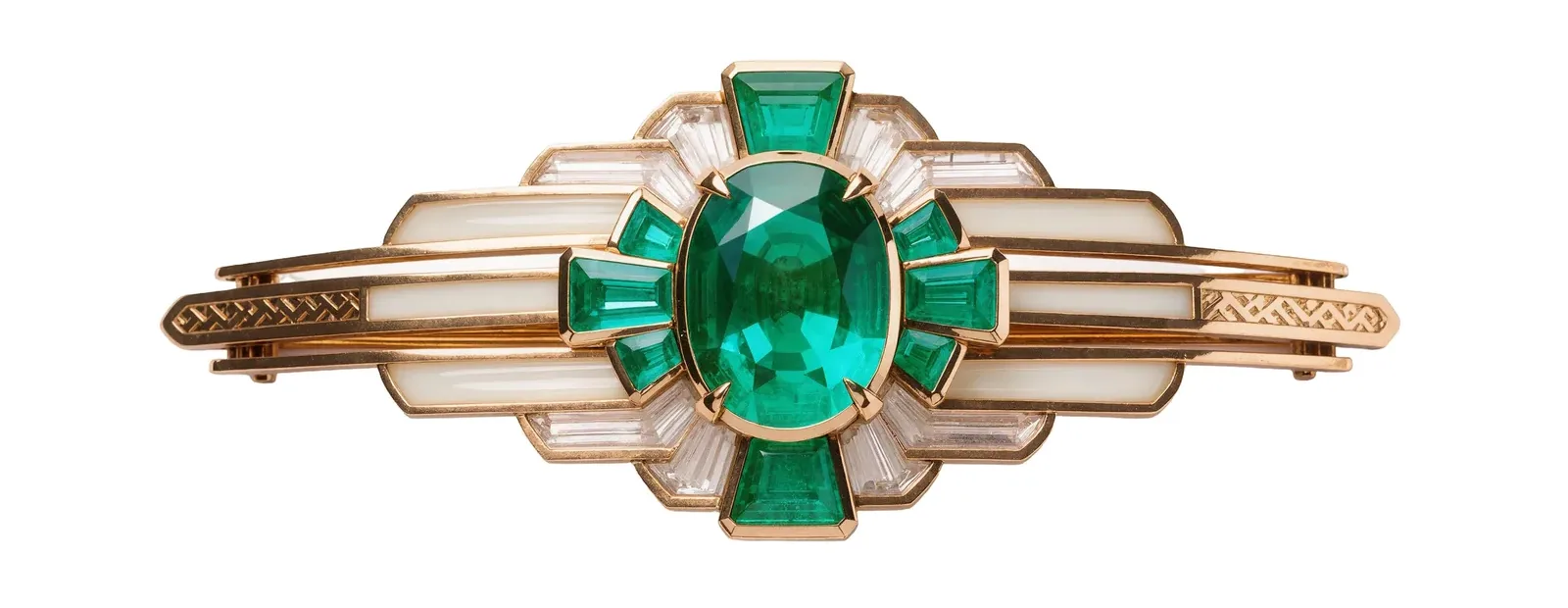
The first is geometry. Stepped forms, sharp angles, and squares and triangles arranged in deliberate symmetry give Deco its architectural quality, and the contrast with what came immediately before could hardly be sharper. After the softness of Edwardian design and the sentimentality of the Victorians, Deco can appear almost severe, which was very much the intention.
Colour is the second, applied with a boldness the preceding eras had largely avoided. Black onyx set against white diamond, coral against platinum, lapis against gold: these are the sort of high-contrast pairings the period delighted in. Often the colour was introduced through calibré-cut stones, small coloured stones cut to fit precisely along the lines of a setting, so that the colour becomes part of the structure of a piece rather than a decorative afterthought. Done well, the effect looks effortless, which rather disguises how difficult it was to achieve.
Platinum dominates the serious work of the era, suiting as it did the fine and exacting settings the style demanded, and the diamonds are almost invariably old European or old mine cut, the modern brilliant not yet having been standardised. This last detail matters more than it might seem. Those older cuts throw a warmer, softer light than a modern stone, with a smaller table and a higher crown, and they account for a great deal of the particular character of an original Deco ring. They are also, as it happens, one of the quickest ways to identify a piece that is not what it claims to be, a point we will return to shortly.
The Major Houses
There is no need to commit the names to memory, but a working familiarity with the principal makers adds a good deal, both to the pleasure of the pieces and to the business of reading the market.
Cartier is the name everyone knows, and its reputation is thoroughly earned. The house’s Deco output is remarkable by any measure: the Tutti Frutti pieces, dense with carved emeralds, rubies, and sapphires, the celebrated mystery clocks, and a long succession of geometric rings, bracelets, and brooches that came to define the period at its very highest level.
Van Cleef & Arpels stands beside Cartier as the other great house of the era. In 1933 the firm patented its Mystery Setting, a technique in which stones appear to be held with no visible metal at all, and which remains extraordinarily difficult to execute even now. Many of the house’s finest Deco pieces make use of it, with invisibly set rubies and sapphires laid across strict geometric forms.
Beyond these two, Boucheron, Mauboussin, and Chaumet all produced work of the first rank in Paris, each with its own subtle preferences: Boucheron inclining towards the architectural, Mauboussin towards adventurous combinations of colour. Across the Atlantic, Tiffany & Co created excellent Deco pieces in a characteristically more restrained American idiom, and the name Black, Starr & Frost is worth knowing for the same reason.
It would be a mistake, however, to fixate entirely on the signatures. A great many regional makers, both British and continental, produced Deco work of genuine quality without ever attaching a famous name to it. Some of the most rewarding pieces in the market are precisely these: unsigned, quietly excellent, and available for a fraction of what a comparable house piece would command.
Art Deco Engagement Rings
Deco engagement rings deserve particular attention, if only because they are by some distance the most requested pieces of the period that pass through our hands.
Their appeal is as practical as it is aesthetic. The geometry sits flat and clean against the finger, the platinum has already demonstrated its durability across the better part of a century, and the proportions tend simply to be right in a way that is easier to feel than to describe. The classic example pairs a transitional or old European cut diamond with a platinum setting and geometric shoulders, sometimes stepped down in diamonds, sometimes accented with a little sapphire or onyx. Sizes vary enormously, and while stones of a carat and more certainly exist, some of the most beautiful pieces sit in the region of a third to two thirds of a carat, where what you are paying for is the craftsmanship rather than the weight of the stone alone. We have stocked Deco engagement rings for as long as we have been trading, and they are seldom in the cabinet for long.
Telling a Genuine Piece from a Reproduction
This is the part that matters most, because the very popularity of Art Deco means the market is thick with pieces made in the style rather than in the period. Some are sold honestly as Deco-inspired, some are described with a convenient vagueness, and a small number are offered as genuine period pieces when they are anything but.
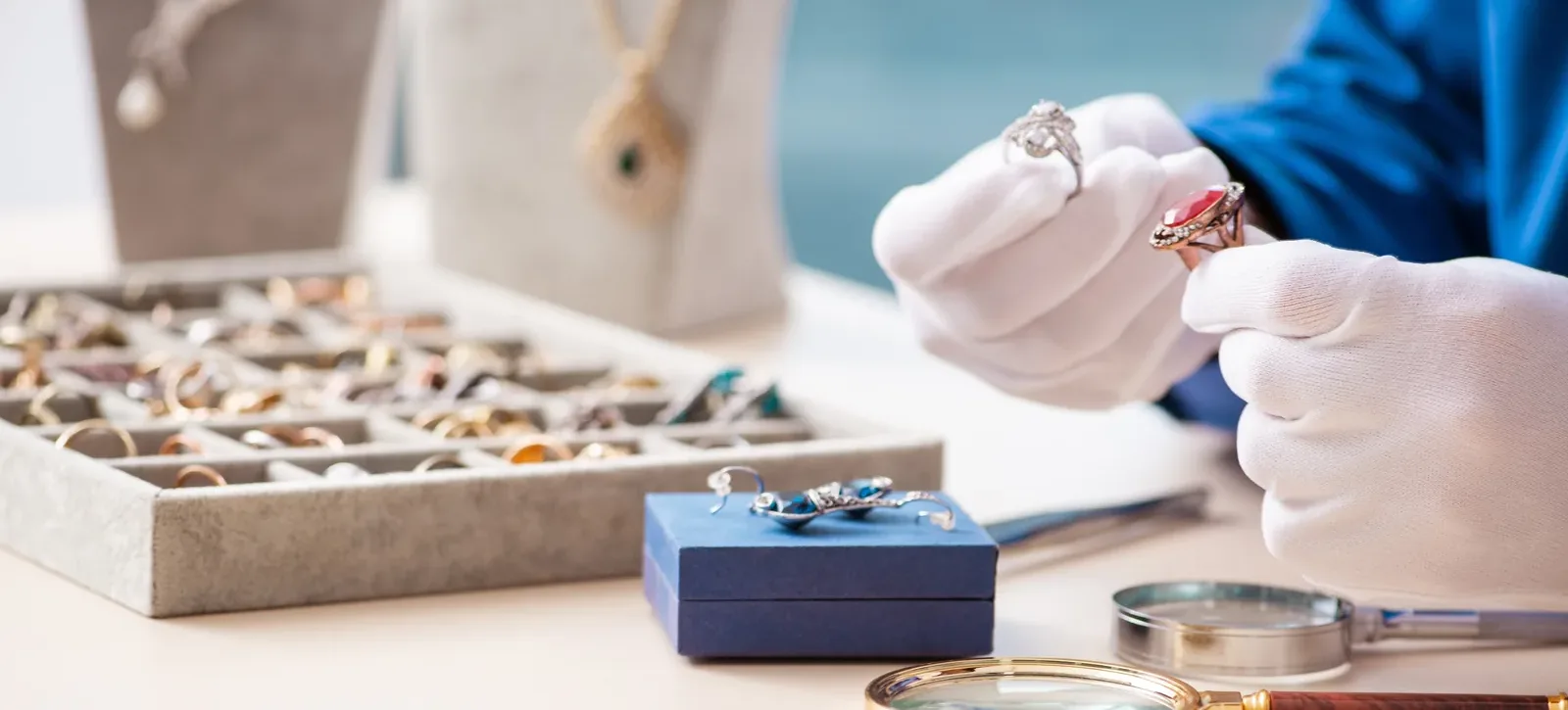
The signs of authenticity are found, for the most part, in the details. Original platinum work possesses a crispness that even accomplished modern reproductions tend to miss, and the calibré-cut accents in a genuine piece fit together with a precision that is usually apparent under a loupe. The diamonds provide the quickest test of all: a ring presented as Deco but set with modern brilliant-cut stones is, at the most generous interpretation, a later reset, and at worst an outright fabrication, since old European cuts are unmistakable to anyone who has handled a few.
Hallmarks are a considerable help. French pieces from the major houses carry maker’s marks and generally a workshop number, British pieces bear the London, Birmingham, or other regional marks of the period, and American work, though often unmarked, should at least show construction consistent with the era. Wear, finally, tells its own quiet story. A ring that has genuinely lived a hundred years wears in particular places, along the back of the shank and in the gallery beneath the stone, and that wear should look like the work of a century of hands rather than something recently applied to lend a false age.
Further Points Worth Checking
Supposing a piece is genuine, a few practical considerations remain.
The condition of the platinum work is the first of them. Deco settings frequently incorporate fine wirework, openwork galleries, and milgrain edges, all of which can soften over the decades, and a piece that has been re-tipped or otherwise restored remains an authentic piece, provided you understand what has been done to it and how sympathetically. The stones warrant a similar question, since diamonds and coloured stones are often exchanged over the course of a century, sometimes with great care and sometimes without; whether an original stone matters to you is a personal judgement, but it is one you should be able to make from full information.
It is also worth asking whether a piece has been converted, because a surprising number of Deco bracelets began life in another form, or surrendered elements of themselves to become rings and brooches in later years. A sympathetic conversion barely troubles the value of a piece, whereas a heavy-handed one certainly does. And there is the matter of the signature, where one exists: a signed piece from one of the major houses commands a genuine premium, and deservedly, though it bears repeating that an unsigned piece of equal quality can prove the more intelligent purchase for a buyer untroubled by the absence of a name.
Art Deco at Farringdons
Our Art Deco era collection spans rings, bracelets, brooches, and earrings from the 1920s and 30s, each piece selected and examined by our team before it reaches the cabinet. We cannot promise every house at every moment, since good Deco tends to move quickly, but we generally hold a considered selection across both signed work and unsigned pieces of comparable standing.
There is a natural overlap, too, with our designer collection, where the Deco pieces happen to carry the marks of Cartier, Van Cleef, and their peers. Should you have something specific in mind, we would encourage you to get in touch and tell us what it is, as we are frequently able to source pieces that never make their way onto the shop floor.