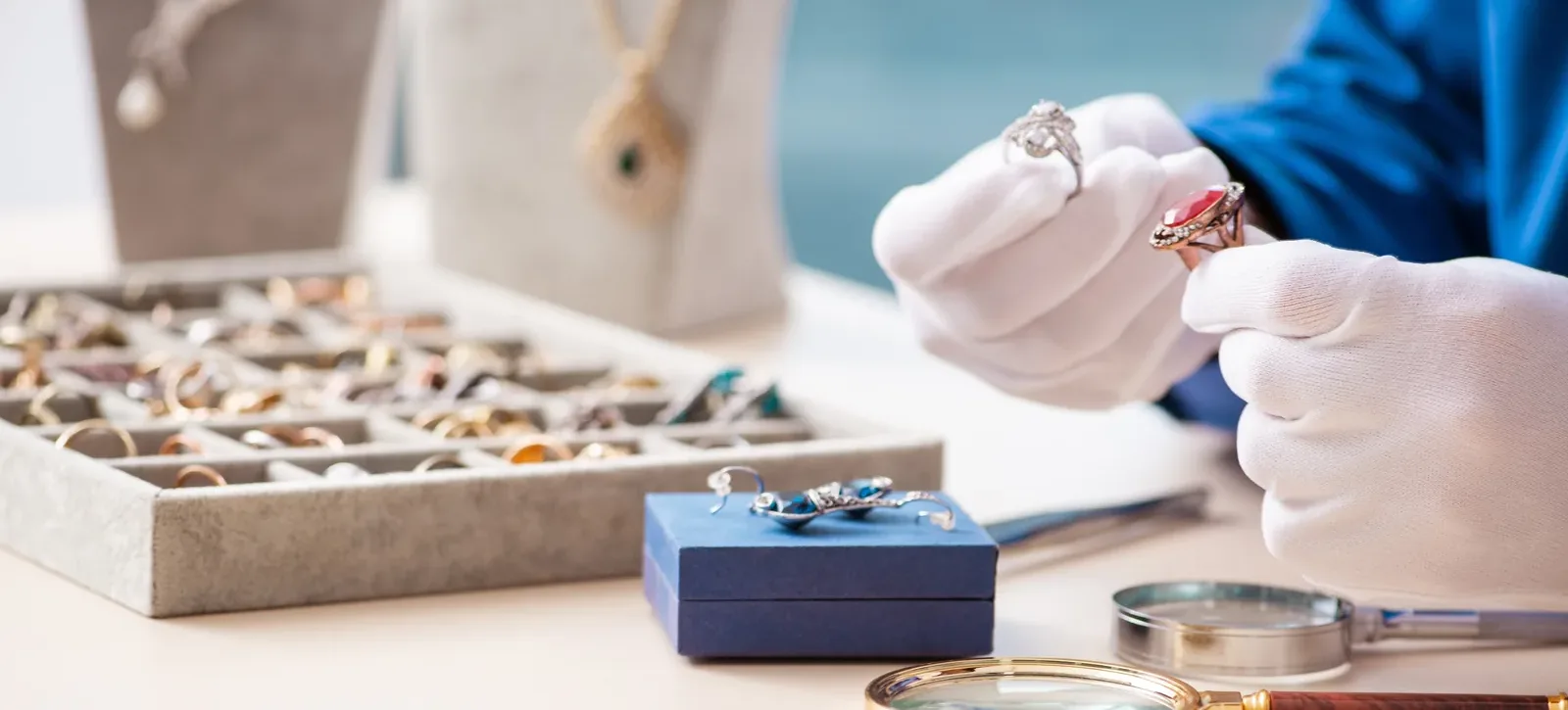
People come to us for valuations for all manner of reasons, though a few recur more often than the rest. Inheritance is the most common by far, usually a ring or a small group of pieces that have spent years in a drawer and now need either a current figure for insurance or simply an honest account of what they actually are. Occasionally it is the reverse: someone parting with a collection assembled patiently over decades. Now and then it follows a divorce, or a house move, or the quiet decision that a piece is no longer worn and might as well be understood. The circumstances vary a great deal, but the underlying questions are remarkably consistent.
If you are weighing up whether to have a piece of antique jewellery valued, or thinking about selling one, the following is a fair account of how the process works, what governs the value you will be quoted, and the questions worth asking before you commit to anything.
Valuation and Selling Are Separate Conversations
It helps to be clear about this distinction from the outset, because the two are easily conflated. A valuation is an assessment of what a piece is worth; selling is a separate decision that may or may not follow from it, and often does not.
A good many people come to us purely for the first of these. They want to understand what they have, whether that means the era, the maker if one can be established, the quality of the stones, or the current market value, and they leave with that knowledge and nothing more. Some return to sell weeks or months later, some never do, and both outcomes are entirely welcome. A valuation carries no obligation, and it should never be presented as though it did.
What Affects the Value of Antique Jewellery
A number of factors come into play, and they carry very different weight depending on the piece in front of you.
The maker matters enormously wherever one can be identified. A piece signed by Cartier, Van Cleef & Arpels, Boucheron, or Tiffany will command a substantial premium over an unsigned equivalent, for the straightforward reason that the market for named pieces runs deeper, the demand holds steadier, and the floor beneath the value sits higher.
Era plays a comparably large role. Art Deco pieces attract consistently strong demand, Edwardian platinum work is held in high regard, and Victorian jewellery varies rather more according to its style and condition. Genuine Georgian pieces are scarce enough that the market for the best of them is both specialist and competitive, which is reflected in the figures they achieve.
Where a piece is dominated by its stones, the quality of those stones tends to become the single largest element in its value. Cut, colour, clarity, and carat weight all bear on the assessment, and while old European and old mine cut diamonds are not graded on the same scale as modern brilliants, they carry a premium of their own among the buyers who appreciate them.
Condition influences value in both directions, and not always as people expect. A piece that survives in original, unaltered form with honest wear will generally hold the most value, whereas one that has been poorly restored, awkwardly converted from something else, or fitted with mismatched replacement stones will be judged accordingly. Sympathetic restoration is frequently a point in a piece’s favour; clumsy work is not. Hallmarks and documented provenance add a further layer of confidence, and a clearly marked piece with a known history will always be worth more than the same piece stripped of both. If you want to understand the marks on a piece of your own, the Goldsmiths’ Company Assay Office guide to tracing a hallmark is a reliable starting point. It would also be less than honest not to acknowledge that the state of the market on any given day plays its part, since demand shifts, and the same Edwardian ring may attract a slightly different figure from one year to the next.
The Different Types of Valuation
These are confused so regularly that they are worth setting out plainly, because the figure you are given means very little until you know which kind it is.
An insurance valuation states a replacement value, namely what it would cost to replace the piece at current retail prices, and it is ordinarily the highest of the three figures precisely because it accounts for retail margin. A probate or fair market valuation, by contrast, records the value at a particular moment for the purposes of an estate, and tends to sit closer to a realistic sale price than to retail replacement. Trade or market value is the figure a buyer within the trade would actually offer, and it is the lowest of the three because it must leave the buyer room to make a margin. If your intention is to sell, this last figure is the one that concerns you, and a reputable valuer will tell you which type they are providing and explain the difference without being asked.
What to Bring
Bring whatever you have. The piece itself is the essential thing, of course, but any documentation that accompanies it earns its place too, whether that means old receipts, previous valuations, insurance schedules, or gemmological certificates. Original boxes and cases are worth including where they survive, as is any family history you can recall about who owned the piece and when.
None of this is strictly necessary, and a competent specialist can assess most pieces on their own merits alone. Each additional piece of context, however, sharpens the assessment and not infrequently supports a stronger valuation, which is reason enough to gather what you can. If a piece carries paperwork from an earlier valuation, bring it even if it is decades old, since it establishes provenance and occasionally records detail about the piece that is no longer visible to the eye.
How the Process Works
An initial valuation with us is, in essence, a conversation. You bring the piece in and we examine it carefully, usually under a loupe and sometimes with further instruments where the piece calls for it, and we talk through what we find: the era, the manner of construction, the stones, the condition, any hallmarks or maker’s marks, and any signs of earlier restoration.
From there we give you our view of what the piece is and, if you are contemplating a sale, what we would offer for it. If you have no intention of selling, we simply provide the information for whatever purpose you require it. What we do not do is press people towards a decision, and a fair number of these conversations end with the owner keeping the piece and leaving better informed than they arrived, which is exactly as it should be. More often than not the conversation proves more valuable than any transaction that might have followed it.
Your Options If You Decide to Sell
Antique jewellery can be sold by three main routes, each carrying its own advantages and compromises.
Selling to a specialist dealer is the most direct and the most predictable of the three. You bring the piece in, a price is agreed, and you leave with payment settled, the offer reflecting what the dealer can confidently sell the piece on for, less their margin. For a piece that sits comfortably within a dealer’s area of expertise, this is frequently the strongest route available.
Auction can serve higher-value pieces well, particularly named-maker work where the pool of buyers is deep and visible. The advantage lies in that exposure; the disadvantages lie in uncertainty, since a piece may exceed its estimate or fall short of it, in the months that typically pass between consignment and sale, and in the fees, which commonly run to between fifteen and twenty-five per cent once buyer and seller premiums and VAT are combined. A private sale through an online platform can produce strong results in the right hands, but it demands effort, patience, and a degree of familiarity with the market, since the piece must be photographed well, described accurately, and authenticated to a buyer’s satisfaction. For a one-off sale it often proves more trouble than the return justifies.
Which of these suits you best depends on what you own, how much time you are prepared to give the matter, and how comfortable you are with uncertainty. We are glad to talk the options through honestly, even on the occasions when doing so points away from a sale to us.
What to Be Wary Of
A few things are worth keeping in mind, whoever you deal with.
Be cautious of lowball offers from non-specialists. Certain buyers, cash-for-gold operations and high-street pawnbrokers chief among them, treat antique pieces as little more than scrap value with a modest premium attached, which for genuinely fine antique jewellery falls well short of what the piece is worth as jewellery in its own right. Be wary, too, of a valuation delivered as a bare figure with no reasoning behind it, since a number offered without explanation is worth very little; a proper valuation should always arrive with an account of what has been assessed and why the figure follows from it.
Any pressure to decide quickly is a reason for caution rather than haste, and walking away to think matters over is always a reasonable course. A specialist who insists on an immediate answer is not acting in your interest. It is worth remembering as well that anyone who also sells competing services, whether an insurer’s in-house valuer, a retailer, or a dealer, carries a potential conflict of interest, which is precisely why independent valuers exist; for a piece of real significance, an independent opinion set alongside any trade offer is well worth the modest cost.
Valuations and Selling at Farringdons
We have been valuing and buying antique jewellery in Hatton Garden for nearly twenty years. Our team handles pieces from across the major periods, from Georgian through to the later vintage decades, and we work equally with individual sellers and with clients managing an estate or a collection.
If you have a piece you would like to understand, or you are giving thought to selling one, we would be glad to arrange a valuation and talk through what you have. There is no charge for the initial conversation, no obligation to sell, and no pressure applied in either direction. You are equally welcome to browse our antique and vintage collection, which gives a good sense of the kinds of pieces we work with day to day.
FAQs
How do I value antique jewellery?
The most reliable route is a valuation from a specialist who handles antique pieces regularly and can assess era, maker, condition, stones, and current demand together. Online price guides offer rough ranges at best, and cannot account for the particulars of an individual piece. For anything of meaningful value, an assessment in person is well worth the time it takes.
What do I need to bring to a jewellery valuation?
The piece itself, together with any documentation, original boxes, certificates, previous valuations, or family history you happen to have. None of it is strictly required, since a specialist can assess most pieces on their own merits, but each additional detail helps, and documented provenance will always support a stronger valuation.
How much does a jewellery valuation cost?
It varies. Initial assessments at most specialist jewellers, ourselves included, are provided free of charge. Written valuations for insurance or probate purposes usually carry a fee, whether as a percentage of the assessed value or a flat rate per piece, and it is sensible to confirm the cost structure before commissioning any formal written document.
Should I sell antique jewellery to a dealer or at auction?
It depends on the piece. Strong named-maker work from houses such as Cartier or Van Cleef often performs well at auction, where the market is deep and the interest visible, whereas unsigned but high-quality pieces frequently do better with a specialist dealer able to sell directly to an established clientele. A good specialist will tell you honestly which route is the likelier to suit your particular piece.